Best GIS Books in 2026: Ranked by What the Job Market Actually Pays For
This guide contains affiliate links. If you buy through them, we earn a small commission at no extra cost to you. Every paid book below is paired with a free alternative — we recommend whichever fits your situation.
Python appears in 26.7% of GIS job listings. SQL shows up in 9.2%. ArcGIS Pro — the tool most U.S. GIS programs still center their curriculum around — appears in just 5.2%. Jobs that list only ArcGIS Pro average $90K. Jobs that combine GIS with Python and cloud skills average $135K+. That's not a salary "premium" — it's a different career tier.
We did something different. We analyzed 1,366 GIS job listings in our database, pulled the most in-demand skills, calculated salary premiums for each, and matched those skills to the books that teach them. The result is a reading list that's connected to how people actually get hired and get paid in this industry.
Here are 8 books worth your time — and a free alternative for every single one. If you're looking for shorter-form credentials instead, see our geospatial certificates and certifications guide.
Python: 26.7% of jobs, +$11.8K salary premium
SQL: 9.2% of jobs, $138K avg salary
ArcGIS Pro only: $90K avg — $45K below Python + cloud roles
LiDAR: +$18K salary premium — highest of any GIS skill
Zero competitor book lists include a database book
How We Chose These Books
Three filters, applied in order:
- Skill demand. We pulled the top 30 skills from 1,366 job listings on GEO CAREERS. If a book doesn't teach something employers are actively hiring for, it didn't make the cut.
- Community signal. We cross-referenced Reddit (r/gis, ~130K members), Esri Community forums, university reading lists, and Amazon sales rankings.
- Currency. If a book teaches ArcMap, references ArcGIS Desktop 10.x, or ships with a DVD, it's out.
Core GIS Foundations
These are "learn what GIS actually is" books. If you're a student, career changer, or self-taught beginner, start here.
GIS Fundamentals (6th Edition) — Paul Bolstad
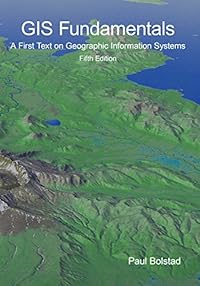
What it teaches: Spatial data models, coordinate systems, projections, spatial analysis, cartographic design. The full foundation, software-agnostic.
Who it's for: Students and career changers who want to understand why GIS works, not just which buttons to click.
Honest take: This is the most-assigned GIS textbook in U.S. universities for a reason — it's clear, software-agnostic, and the kind of reference you'll crack open years later. At $90+ it's not cheap. But if you can only afford one foundational book, pick this over any Esri-specific intro.
Free alternative: GIS Commons covers similar foundational concepts as a free, open-source e-textbook.
Getting to Know ArcGIS Pro — Michael Law & Amy Collins
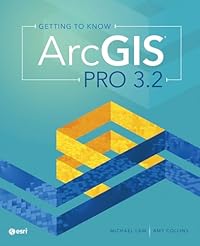
What it teaches: Hands-on ArcGIS Pro workflows — mapping, editing, spatial analysis, 3D visualization. Step-by-step exercises with provided data.
Who it's for: Anyone who needs to learn ArcGIS Pro specifically. Comes with an ArcGIS trial license.
Honest take: ArcGIS Pro proficiency alone isn't what gets you paid. Jobs listing only ArcGIS Pro average $90K — about $45K less than roles that add Python and cloud skills. Think of this as your foundation, not your ceiling. ArcGIS appears in 12.9% of our job listings at $120K average — it's still the industry standard. But the premium comes from combining it with other skills.
Free alternative: Esri offers free MOOCs and tutorials that cover 80% of the same material.
Python for GIS
Python is the #1 skill in GIS job listings. Period. It appears in 365 of 1,366 jobs (26.7%) and carries an $11,767 salary premium. If you invest in one skill category beyond core GIS, make it this one.
Automate the Boring Stuff with Python (3rd Edition) — Al Sweigart
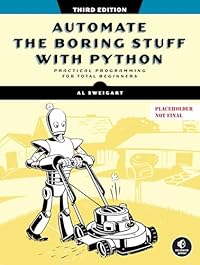
What it teaches: Python fundamentals — variables, loops, functions, file manipulation, web scraping, Excel automation. No GIS content, but that's the point.
Who it's for: Anyone who has never written code. Every r/gis thread asking "where do I start with Python?" gets the same answer: learn fundamentals first, specialize later.
Honest take: This isn't a GIS book. It's a "learn to code" book. Jumping straight into ArcPy without understanding functions and loops is a recipe for frustration. The entire book is free online, so there's no excuse not to start here.
Free alternative: The book itself is free at automatetheboringstuff.com.
Python Scripting for ArcGIS Pro — Paul Zandbergen
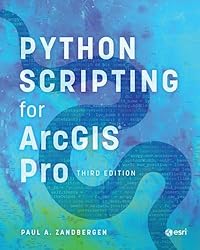
What it teaches: ArcPy — automating geoprocessing, managing spatial data, building tools, working with map documents programmatically in ArcGIS Pro.
Who it's for: GIS analysts who already know some Python and work in an Esri environment. This is the bridge book — the one that turns "I can write a for loop" into "I automated a workflow that used to take three days."
Honest take: This is where the salary premium lives. Python + ArcGIS jobs co-occur 65 times in our database. It's the most practical path from "GIS Analyst who uses buttons" to "GIS Analyst who automates things." That transition is worth about $12K/year, based on our data.
Free alternative: Esri's free Python scripting courses and the ArcPy documentation cover the basics.
Learning Geospatial Analysis with Python (4th Edition) — Joel Lawhead
What it teaches: Geospatial analysis using open-source Python libraries — GeoPandas, Shapely, Fiona, Rasterio, GDAL. Covers vector and raster analysis without touching Esri software.
Who it's for: GIS professionals who want Python skills that work outside the Esri ecosystem. Data scientists moving into geospatial work.
Honest take: If Zandbergen's book is the Esri path, Lawhead's is the open-source path. Both are valid. The open-source route has a steeper learning curve but gives you more transferable skills. Python + PostgreSQL appears in 59 jobs in our data at $131K average.
Free alternative: Introduction to GIS Programming by Qiusheng Wu (2025, open-source). Also Geographic Data Science with Python by Sergio Rey.
Spatial Databases & SQL
Here's the gap nobody else covers. SQL is the #5 most demanded skill in GIS job listings (9.2%, 125 jobs) with a $138K average salary. PostGIS specifically appears in 58 jobs at $145K average. Every competitor "best GIS books" list we analyzed recommends zero database books.
Spatial SQL — Matthew Forrest, Tyler J. Mitchell & Keith Mitchell
What it teaches: SQL for spatial data — querying geographic features, spatial joins, indexing, working with PostGIS.
Who it's for: GIS professionals who interact with spatial databases (so... most of them, eventually). Data engineers building geospatial pipelines.
Honest take: SQL is the skill that separates "GIS technician" from "geospatial professional." SQL + PostGIS roles average $145K in our database — that's $12K above baseline. If everyone's learning Python (and they should), learning SQL alongside it puts you in a smaller, better-paid pool.
Free alternative: The PostGIS documentation and tutorial section are genuinely good. Paul Ramsey's PostGIS talks on YouTube are another free entry point.
Cartography & Visualization
Designing Better Maps: A Guide for GIS Users (3rd Edition) — Cynthia Brewer
This won't get you hired by itself. But bad maps undermine otherwise solid analysis, and cartographic competence is expected in almost every GIS role.
Brewer created ColorBrewer — the color selection tool most GIS professionals already use. This book covers map layout, color theory, labeling, typography, and the visual hierarchy decisions that separate a map that communicates from one that confuses.
Who it's for: Everyone. If your maps look like default ArcGIS output, this is the fix. At ~$50, it's also one of the cheaper books on this list.
Free alternative: ColorBrewer tool, the Esri cartography blog, and Kenneth Field's writings on cartographic principles.
Remote Sensing
Remote sensing appears in 6.8% of GIS listings with a $136K average salary. LiDAR carries an $18K salary premium — one of the highest of any GIS skill.
Remote Sensing and Image Interpretation (7th Edition) — Lillesand, Kiefer & Chipman
What it teaches: The physics of remote sensing — how electromagnetic radiation becomes data — plus interpretation methods for LiDAR, thermal, radar, and optical imagery.
Who it's for: Anyone pursuing remote sensing as a specialization. Students in geography or environmental science programs.
Honest take: This is the textbook. It's been the academic standard since its first edition. Comprehensive and well-illustrated. The downside: dense, expensive (~$80+), and more theoretical than practical. Pair it with hands-on tutorials in Google Earth Engine or Python rasterio.
Free alternative: The EEFA textbook is a 55-chapter, open-access book on cloud-based remote sensing with Google Earth Engine. Also: Spatial Thoughts offers free GEE courses.
Free Resources Worth Your Time
Not everyone can spend $50–100 per book, and some free resources rival the paid ones.
For GIS fundamentals:
- GIS Commons — Free open-source textbook
- Essentials of GIS — Open textbook from University of Minnesota
For Python + GIS:
- automatetheboringstuff.com — Full text free online
- Introduction to GIS Programming — Qiusheng Wu's 2025 open-source Python GIS book
- Geographic Data Science with Python — Sergio Rey
- Introduction to Python for Geographic Data Analysis
For remote sensing:
- EEFA textbook — 55 chapters, Google Earth Engine focused, open access
For R users:
- Geocomputation with R — Lovelace et al., free online. R appears in 4.2% of listings.
For QGIS:
- QGIS official documentation
- Spatial Thoughts OpenCourseWare — Free QGIS, Python, and GEE courses
The free path is entirely viable for learning GIS foundations and Python. Paid books add the most value as structured learning sequences and reference material you return to repeatedly.
Which Books Should You Read?
Just Starting Out
- GIS Fundamentals (Bolstad) or Getting to Know ArcGIS Pro — theory-first or hands-on-first
- Automate the Boring Stuff — start Python early
- Designing Better Maps (Brewer)
Working GIS Analyst Leveling Up
- Python Scripting for ArcGIS Pro (Zandbergen)
- Spatial SQL (Forrest et al.)
- Pick your specialty: Lillesand (remote sensing) or Lawhead (open-source Python)
From Data Science
- Skip Bolstad — start with Lawhead (maps Python to geospatial libraries)
- Spatial SQL for database skills
From Environmental Science
- Bolstad for the spatial thinking framework
- Zandbergen to automate analysis you're already doing manually
From Software Engineering
- Skip intro books entirely
- Spatial SQL + Lawhead — you'll be productive in weeks
Professors Building a Curriculum
- GIS Fundamentals for intro courses (software-agnostic)
- Add Automate the Boring Stuff — Python is in 26.7% of listings
- Getting to Know ArcGIS Pro if you have Esri licenses
Start With One Book
Don't buy all eight of these. Pick one. Read it. Build something with what you learn. Then come back for the next one.
The biggest mistake is treating book buying as progress. It's not. Books are inputs. The output is the project you ship and the workflow that used to take three days and now takes ten minutes.
As of Q1 2026, only 10.2% of GIS job listings in our database are entry-level. The other 90% are looking for people who can demonstrate competence through work, not coursework. A portfolio on GitHub matters more than a stack of textbooks on your desk.
One book. One project. Then we'll talk about book number two.